When people think about kitchen design, they often jump straight to countertops, appliances, or backsplashes. But in reality, cabinet door styles are what define the entire look and feel of your kitchen. Cabinet doors take up the largest visual surface in the space, which means your choice of door design has a bigger impact than almost any other design decision.
The right kitchen cabinet door styles influence more than just aesthetics. They affect your overall budget, how durable your cabinets are over time, how easy they are to maintain, and even how complex the installation process becomes. Some types of cabinet doors are versatile and cost-effective, while others demand precision craftsmanship and expert installation.
In this guide, you’ll learn about the main types of cabinet doors, the most popular kitchen cabinet door styles, construction methods, finishes, and how to choose the right combination for your space.
Main Types of Kitchen Cabinet Doors (Construction & Overlay)
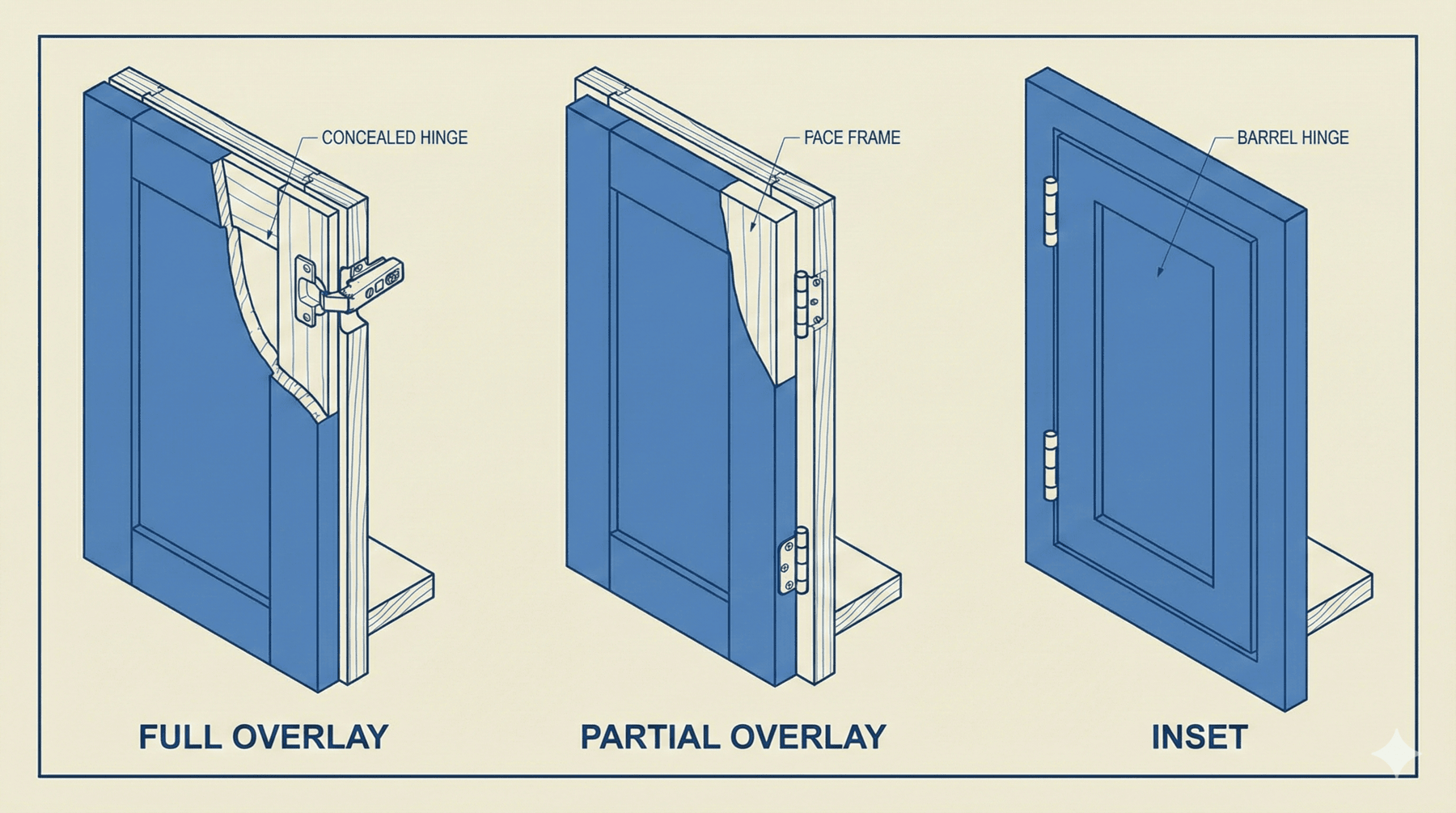
It’s important to understand that “cabinet door type” and “cabinet door style” are not the same thing. Cabinet door type usually refers to how the door is constructed or mounted (like inset or overlay), while cabinet door style refers to the visual design (like Shaker or slab). Let’s look at some common types of cabinet doors in detail.
Full Overlay Cabinet Doors

Full overlay cabinet doors are designed to cover nearly the entire cabinet face frame, leaving only small, consistent gaps between doors and drawers.
These types of cabinet doors typically require precise manufacturing because even small measurement errors become noticeable. They are often paired with concealed hinges, which help maintain a clean, uninterrupted appearance.
Full overlay cabinet doors work especially well in modern and transitional kitchens. They are also commonly used with frameless (European-style) cabinetry, where sleek lines are a priority.
Pros:
- Creates a seamless, high-end appearance
- Maximizes usable drawer and door size
- Fewer visual seams, which feel cleaner and more modern
Cons:
- Slightly higher cost than other options
- Requires accurate measurements and careful installation
Full overlay doors are a common choice for new builds, luxury apartments, and modern residential developments because of their upscale aesthetic.
Partial Overlay Cabinet Doors

Partial overlay cabinet doors cover only part of the cabinet face frame, leaving more of the frame visible between doors. A standard overlay size is often around ½ inch, though this can vary.
These kitchen cabinet door styles can work with either exposed hinges or semi-concealed hinges, offering flexibility in design and budget.
Partial overlay is ideal for traditional kitchens and cost-conscious projects. It remains one of the most widely used types of cabinet doors in large residential builds because it balances appearance with affordability.
Pros:
- More budget-friendly than a full overlay or inset
- Easier to align during installation
- Delivers a classic, familiar look
Cons:
- Visible gaps create a less modern aesthetic
- Less seamless than full overlay designs
Partial overlay doors are especially well-suited for multi-unit housing and value-engineered residential projects.
Inset Cabinet Doors

Inset cabinet doors are installed flush inside the cabinet frame, rather than sitting on top of it. This creates a refined, furniture-like appearance that feels intentional and architectural.
Among all types of cabinet doors, inset requires the highest level of precision. Exact measurements are critical, and professional installation is strongly recommended. Inset doors can be paired with either exposed decorative hinges or concealed hardware, depending on the design goal.
These doors are often seen in high-end, custom kitchens and luxury residential spaces.
Pros:
- Elegant, premium appearance
- Timeless design appeal
- Creates a custom, furniture-grade look
Cons:
- Most expensive option
- Sensitive to humidity and seasonal expansion
- Requires expert craftsmanship and installation
Inset cabinet doors are commonly used in bespoke residential projects and premium developments where detail and craftsmanship are priorities.
Kitchen Cabinet Door Styles (Design & Appearance)
While door type focuses on construction, cabinet door styles focus on design and visual impact. These styles can typically be paired with multiple construction types (full overlay, partial overlay, or inset).
Shaker Cabinet Doors

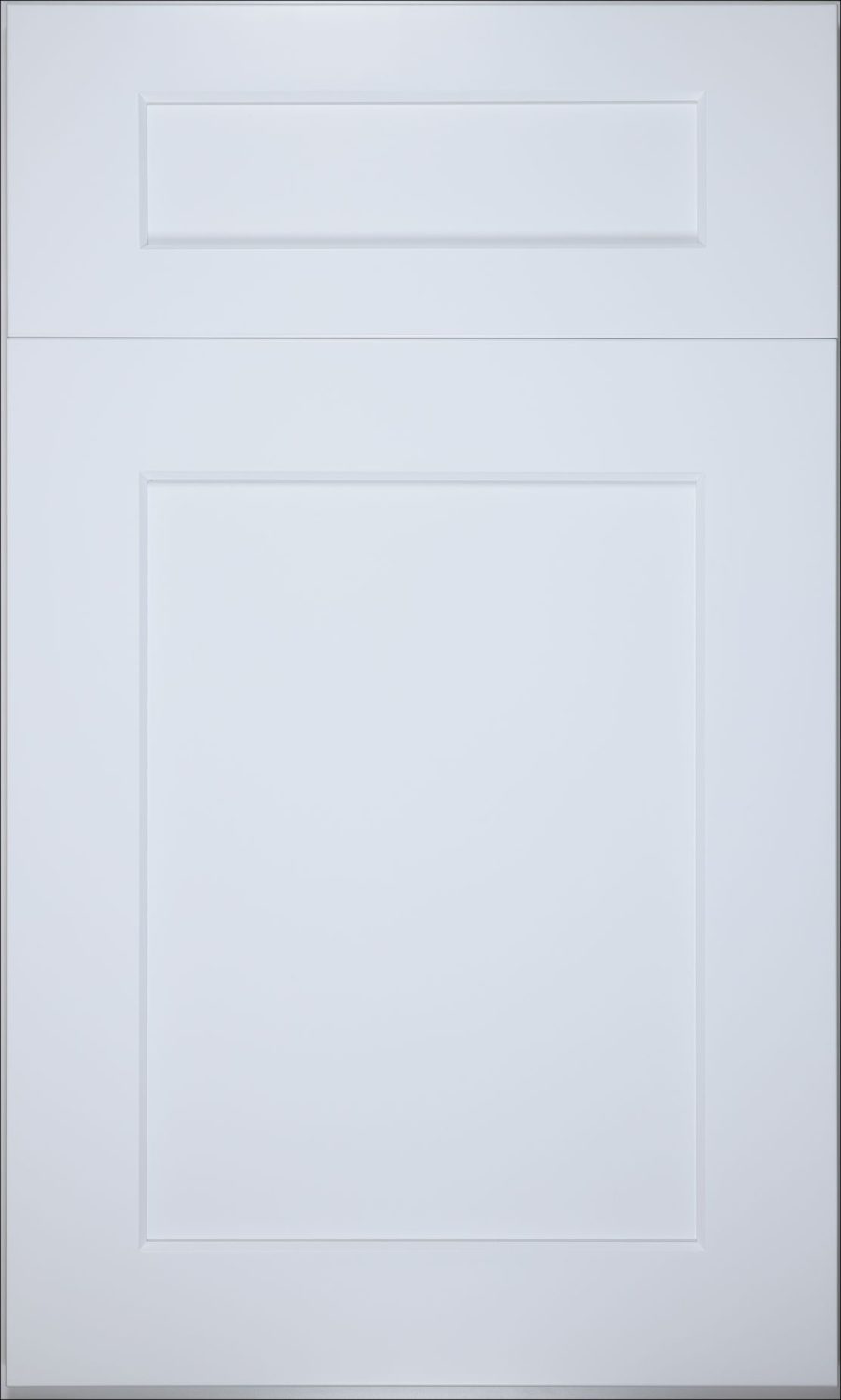
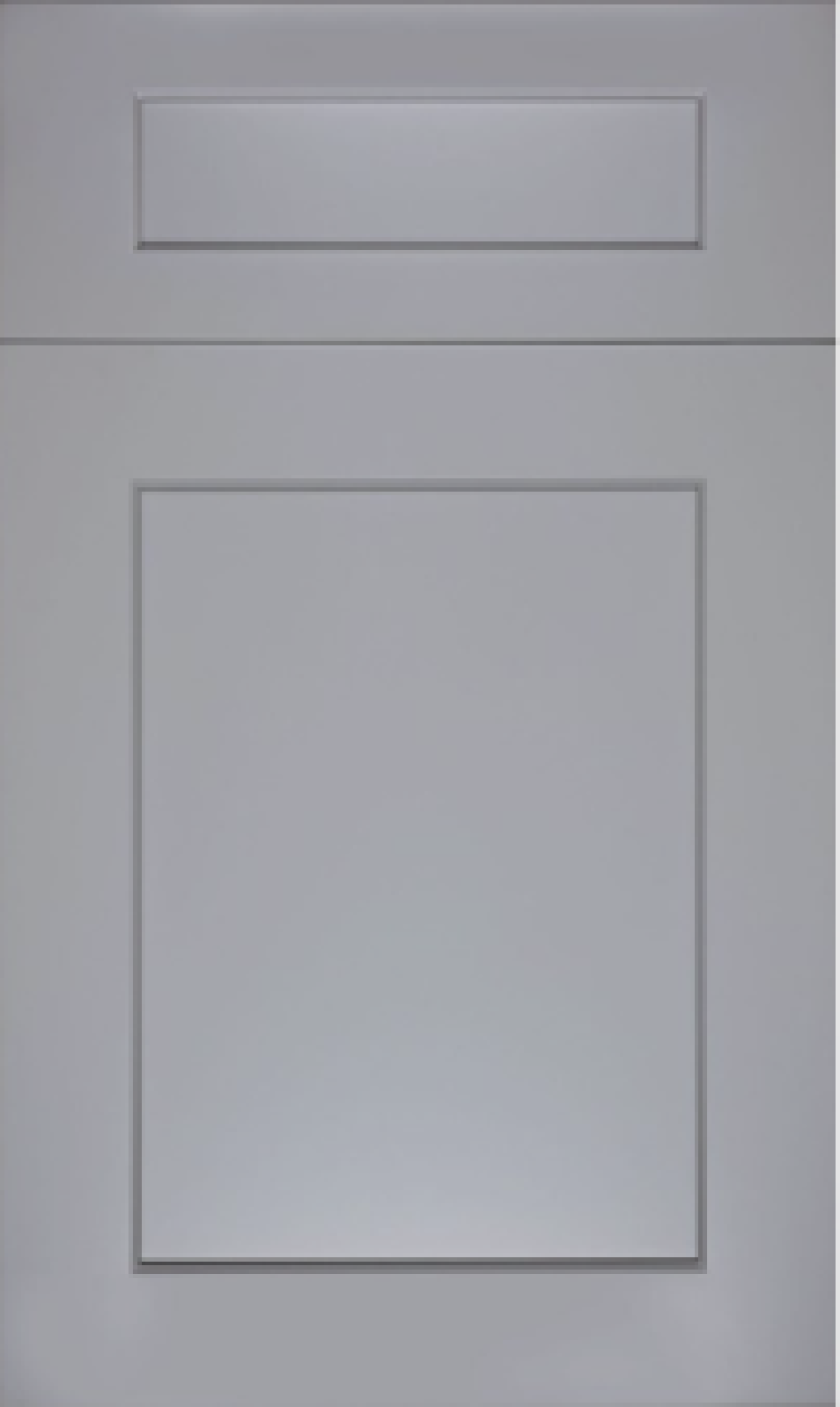
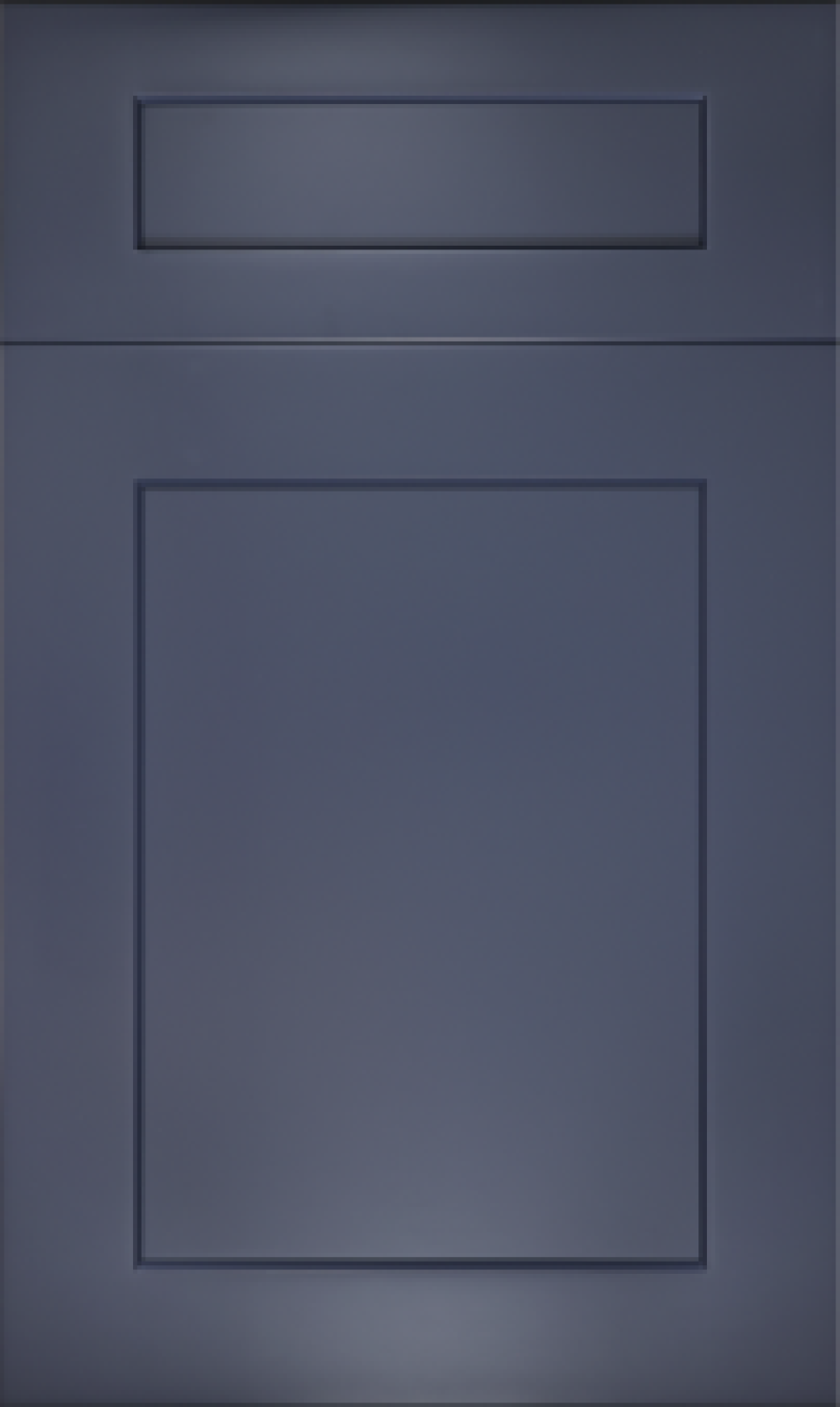
Shaker is one of the most popular kitchen cabinet door styles today. It features a five-piece construction with a recessed center panel and clean, simple lines.
Shaker doors work beautifully in transitional kitchens, modern farmhouse designs, and contemporary spaces. Their versatility makes them a favorite across a wide range of home styles.
Here’s why homeowners and designers love them:
- Timeless, adaptable design
- Work well with painted or stained finishes
- Scale efficiently for both custom and large-scale production
Flat Panel (Slab) Cabinet Doors

Flat panel, also known as slab cabinet doors, are made from a single flat piece with no frame or decorative detailing. This makes them one of the most minimalistic cabinet door styles available.
They are best suited for modern and minimalist kitchens, especially when paired with frameless cabinetry.
Advantages:
- Clean, contemporary appearance
- Easy to maintain due to smooth surfaces
- Often more cost-efficient to manufacture
Raised Panel Cabinet Doors

Raised-panel doors feature a center panel elevated above the surrounding frame, often with decorative edges or profiling. These are among the most traditional kitchen cabinet door styles.
They are commonly used in classic and formal kitchens, especially in luxury homes.
Design notes
- Heavier visual presence
- Often paired with stained finishes to highlight wood grain
- Creates a rich, traditional atmosphere
Beadboard Cabinet Doors

Beadboard cabinet doors include vertical grooves or bead detailing on the panel. This adds texture and visual character, making them a strong choice for relaxed, inviting spaces.
They work especially well in cottage-style, coastal, and farmhouse kitchens.
Beadboard doors are excellent for adding charm without overwhelming the rest of the design.
Glass Front Cabinet Doors

Glass front doors incorporate a glass panel within a cabinet door frame. The glass can be clear, frosted, textured, or designed with mullions, depending on the look you want.
These cabinet door styles are often used for upper cabinets, display cabinets, or accent areas.
Use Case
Glass front cabinet doors are often chosen in kitchens designed for entertaining, where presentation matters just as much as function. Homeowners commonly use them in upper cabinets above beverage stations, coffee bars, or dining-adjacent storage so that glassware, ceramics, and curated pieces become part of the décor.
In smaller kitchens, designers use glass fronts near windows or corners to prevent the space from feeling boxed in, allowing light to move more freely and making the room feel larger and more open.
Louvered Cabinet Doors

Louvered cabinet doors feature horizontal slats that allow for airflow. While less common, they offer a distinctive aesthetic. They are often used in coastal-inspired kitchens, utility spaces, or specialty applications such as pantry cabinets.
Louvered cabinet doors are especially practical in areas where airflow is important, such as pantry cabinets that store produce, utility cabinets housing appliances, or laundry-adjacent storage. In coastal homes, they’re often used intentionally as a design feature to reinforce the relaxed, breezy aesthetic while still serving a functional purpose. While they require slightly more upkeep, homeowners who prioritize character and ventilation often find them worth the tradeoff.
Note: While visually unique, louvered doors require more maintenance due to the grooves.
Optional Additional Styles
Other types of cabinet doors and styles you may encounter include recessed-panel doors, mullion cabinet doors, and handleless or integrated pull designs. These are often used selectively depending on architectural style and project needs.
These cabinet door styles are typically used in more design-driven projects rather than throughout an entire kitchen. For example, mullion cabinet doors are frequently installed in a small number of upper cabinets to create a focal point, while handle-less or integrated pull doors are most common in ultra-modern kitchens where maintaining uninterrupted lines is a top priority. Recessed panel doors are often selected for transitional homes where homeowners want something more detailed than slab, but less traditional than raised panel.
Framed vs Frameless Cabinet Construction

Beyond door style and type, cabinet construction also plays a key role in how your kitchen cabinet door styles function.
Framed Cabinets
Framed cabinets include a face frame attached to the cabinet box. This is the most common construction method in North America.
Pros:
- Strong structural support
- Works well with traditional cabinet door styles
- Compatible with partial overlay and inset doors
Frameless (European-Style) Cabinets
Frameless cabinets eliminate the face frame, allowing doors to attach directly to the cabinet box.
Pros:
- More accessible interior storage
- Cleaner, modern appearance
- Faster installation in many projects
Frameless construction is increasingly popular in modern developments and multi-unit residential projects because of efficiency and aesthetics.
Cabinet Door Finishes: Painted vs Stained

The finish you choose can dramatically affect how your cabinet door styles appear.
Painted Cabinet Doors
Painted cabinet doors offer a smooth, uniform appearance and nearly unlimited color options.
They work particularly well with Shaker and slab kitchen cabinet door styles and are ideal for modern and transitional kitchens.
Stained Cabinet Doors
Stained finishes enhance the natural wood grain, creating depth and warmth. They are best suited for traditional designs, especially raised-panel and classic cabinet-door styles.
How to Choose the Right Cabinet Door Type & Style
Choosing among the many types of cabinet doors doesn’t have to be overwhelming when you focus on a few practical factors.
Consider your budget first. Partial overlay doors and slab styles tend to be more affordable, while inset and custom detailing raise costs.
Project scale also matters. Large developments may prioritize efficiency and consistency, while custom homes often focus on detail and craftsmanship.
Think about your design style. Modern spaces typically favor slab or full-overlay Shaker doors, while traditional kitchens often lean toward raised-panel or inset designs.
Durability and maintenance are also important. Highly detailed doors may require more cleaning, while flat surfaces are easier to maintain long-term.
Finally, consider timelines. Some kitchen cabinet door styles require longer manufacturing lead times, especially custom inset or specialty designs.
| Category | Type | Cost Level | Best For |
| Overlay Type | Full Overlay | Higher cost | Modern, seamless look |
| Overlay Type | Partial Overlay | Budget-friendly | Classic, familiar appearance |
| Overlay Type | Inset | Premium cost | Luxury, custom aesthetic |
| Door Style | Shaker | Moderate | Versatile, suits most kitchens |
| Door Style | Slab | Often affordable | Modern and minimalist designs |
| Door Style | Raised Panel | Moderate–High | Traditional kitchen styles |
Common Mistakes to Avoid When Choosing Cabinet Doors
One of the most common mistakes homeowners make is mixing incompatible cabinet door styles and construction types. For example, pairing ultra-modern slab doors with highly traditional architectural elements can create a visual disconnect.
Another issue arises when homeowners choose inset doors without considering humidity and climate control. Because inset doors sit within the frame, environmental changes can affect their performance.
It’s also easy to prioritize aesthetics over function. Some types of cabinet doors look beautiful in photos, but require more maintenance than your lifestyle realistically allows.
Final Thoughts: Selecting Cabinet Doors for Long-Term Value
Cabinet doors are not a short-term design decision. They shape how your kitchen looks and functions for decades. The right combination of cabinet door type, cabinet door style, construction method, and finish ensures your kitchen remains both beautiful and practical.
By understanding the different types of cabinet doors and exploring the wide range of kitchen cabinet door styles, you can make informed decisions that align with your budget, your aesthetic, and your long-term goals.
When quality manufacturing and thoughtful design come together, your cabinet doors become more than just functional components, they become the foundation of your kitchen’s identity.